Why Hi-Vis Garments Fail EN ISO 20471 Testing — and How to Prevent It
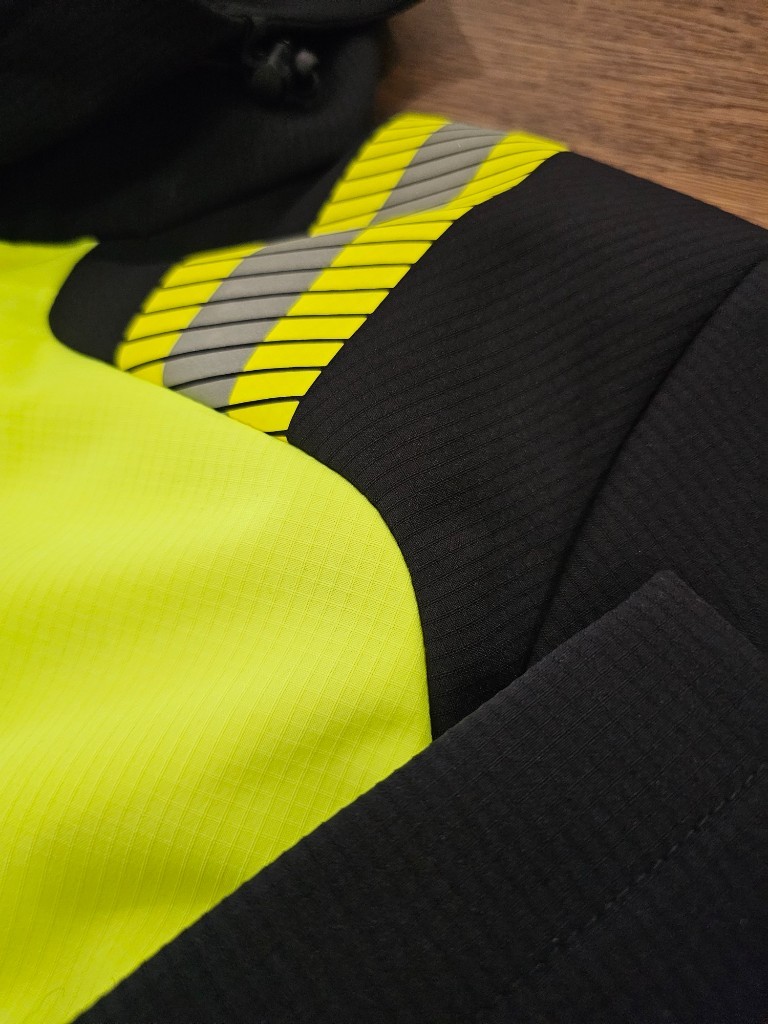
A hi-vis garment can be well made, look correct and still produce an unacceptable test result.
That is because EN ISO 20471 deals with measurable performance rather than appearance alone.
Fluorescent colour is measured instrumentally. Reflective material has to maintain defined performance. The finished garment needs sufficient qualifying material, arranged correctly. Relevant properties also need to remain suitable following specified exposure or care treatments.
When a problem occurs, the sewing factory is not necessarily the root cause.
A failure may have originated with the dye house, fabric mill, reflective-tape supplier, product designer, application process or an uncontrolled change made after the original garment was approved.
Understanding where failures come from makes them much easier to prevent. For garment-level rules — classes, minimum material areas and tape placement — see our EN ISO 20471 buyer's guide.
In this article
- A useful way to think about hi-vis failures
- 1. Fluorescent colour falls outside the permitted range
- 2. The colour passes initially but changes after Xenon exposure
- 3. Dark contrast fabric contaminates the fluorescent material
- 4. Reflective tape performs when new but drops after pre-treatment
- 5. The finished garment has insufficient fluorescent area
- 6. The smallest size falls short
- 7. Branding changes the compliant area
- 8. Reflective tape is positioned incorrectly
- 9. The fabric changes excessively after care
- 10. A supplier substitutes "equivalent" material
- 11. Application settings change between development and bulk
- 12. The production team is working from the wrong approval
- Why an experienced hi-vis factory can still have failures
- A better pre-testing checklist
- Testing should confirm the development, not finish it
A useful way to think about hi-vis failures
Most problems can be traced back to one of four areas:
| Failure area | Typical origin |
|---|---|
| Fluorescent colour or fabric performance | Mill / dye house |
| Retroreflective performance | Tape + application process |
| Insufficient area or incorrect placement | Garment design |
| Certified product differs from bulk | Production control |
The laboratory result may expose the problem, but the cause usually happened much earlier.
1. Fluorescent colour falls outside the permitted range
What goes wrong
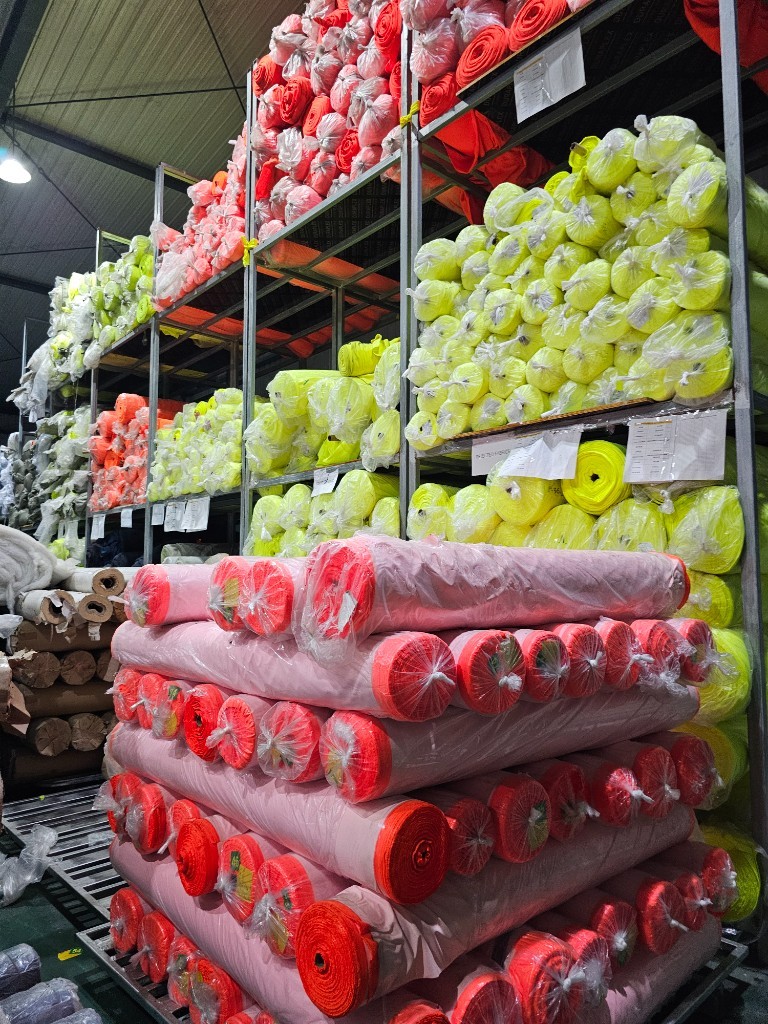
The fabric looks like hi-vis yellow, orange-red or red, but instrumental measurement does not meet the required colour criteria.
EN ISO 20471 defines the fluorescent colours in terms of chromaticity coordinates and luminance. SATRA confirms that these are assessed using a spectrophotometer rather than by visual inspection.
Why it happens
Possible causes include:
- incorrect dye formulation
- poor dye-lot control
- material substitution
- variation in the substrate
- changes to finishing
- insufficient control between lab approval and bulk
The complication is that the buyer may see nothing obviously wrong.
Two fluorescent yellows can look similar under office lighting while producing different instrument readings. For more on what fluorescent background fabrics need to deliver, see Hi-Vis Fabrics Explained.
How to prevent it
Work against an exact nominated fabric article and approved colour rather than a general description such as "fluorescent yellow polyester".
For repeat programmes, bulk dye-lot control matters just as much as the first development test.
The aim is not to make one compliant sample. It is to reproduce the same performance over subsequent production.
2. The colour passes initially but changes after Xenon exposure
What goes wrong
The new fabric meets the colour requirement but does not retain the required performance after accelerated light exposure.
SATRA confirms that background materials are assessed after exposure to a Xenon arc lamp and that colour is measured on both new and exposed specimens.
Why it happens
Fluorescent colours can be technically demanding.
The initial shade may be correct, but the dye system may not have sufficient stability when exposed to light.
Problems can also appear after a mill changes dye route, substrate, chemicals or finishing while assuming the replacement remains equivalent.
How to prevent it
Do not judge suitability from initial shade approval alone.
Relevant test evidence needs to cover the actual fluorescent article being specified, including its performance after the required exposure.
If a material is changed later, review the evidence again.
3. Dark contrast fabric contaminates the fluorescent material
What goes wrong
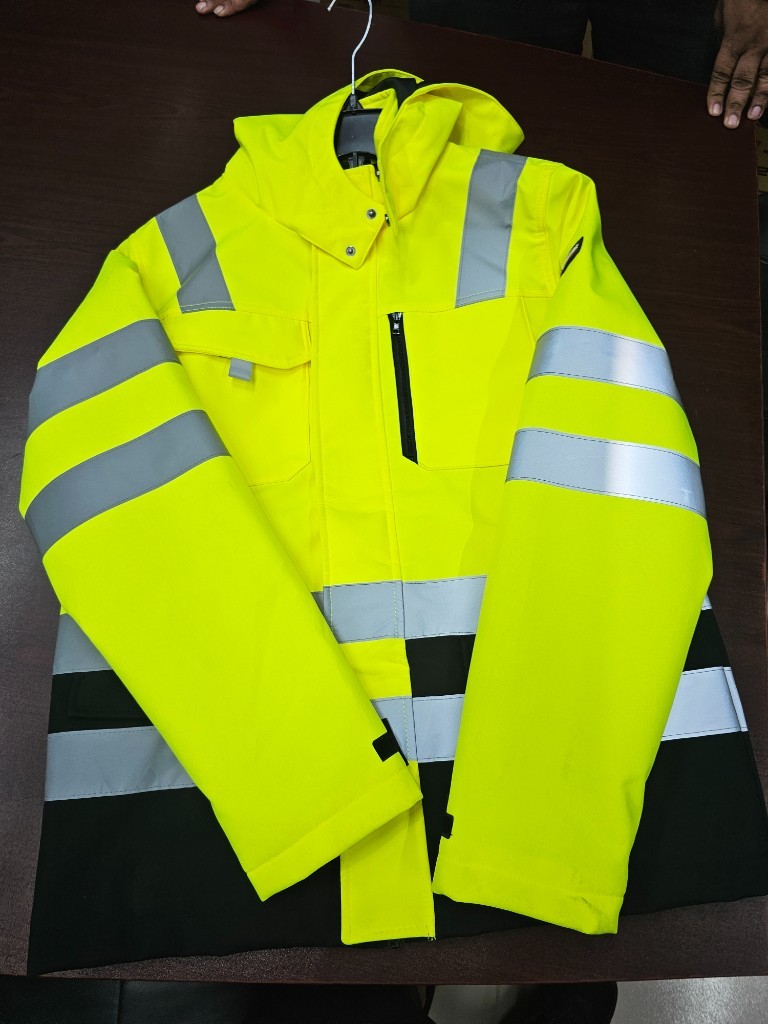
A two-tone garment uses fluorescent fabric beside black, navy or another dark contrast colour.
During care testing, dye migration or staining affects the fluorescent section.
Colourfastness matters because the background material needs to retain the colour performance required for visibility. SATRA identifies colourfastness to care agents as part of the material assessment.
Why it happens
The fluorescent fabric may be perfectly good on its own.
The problem can originate in the adjacent dark material.
This is why testing individual fabrics independently does not always reveal every risk in a multi-material garment.
How to prevent it
Evaluate the complete colour combination and intended care route.
Pay particular attention to dark trims, rib, stretch panels, reinforcement areas and other components directly adjacent to fluorescent fabric.
4. Reflective tape performs when new but drops after pre-treatment
What goes wrong
Initial retroreflective performance is satisfactory, but the material does not maintain the required level after specified treatment.
Retroreflectivity is measured on both new and pre-treated material. SATRA identifies treatments including washing and other physical exposures, while its technical guidance also references abrasion, flexing, cold folding, temperature cycling and simulated rainfall.
Why it happens
Typical causes include:
- inappropriate tape selection
- unsuitable care claim
- poor durability of the reflective construction
- application conditions outside the tape manufacturer's recommendation
- an incompatible garment substrate
- substitution of the nominated tape
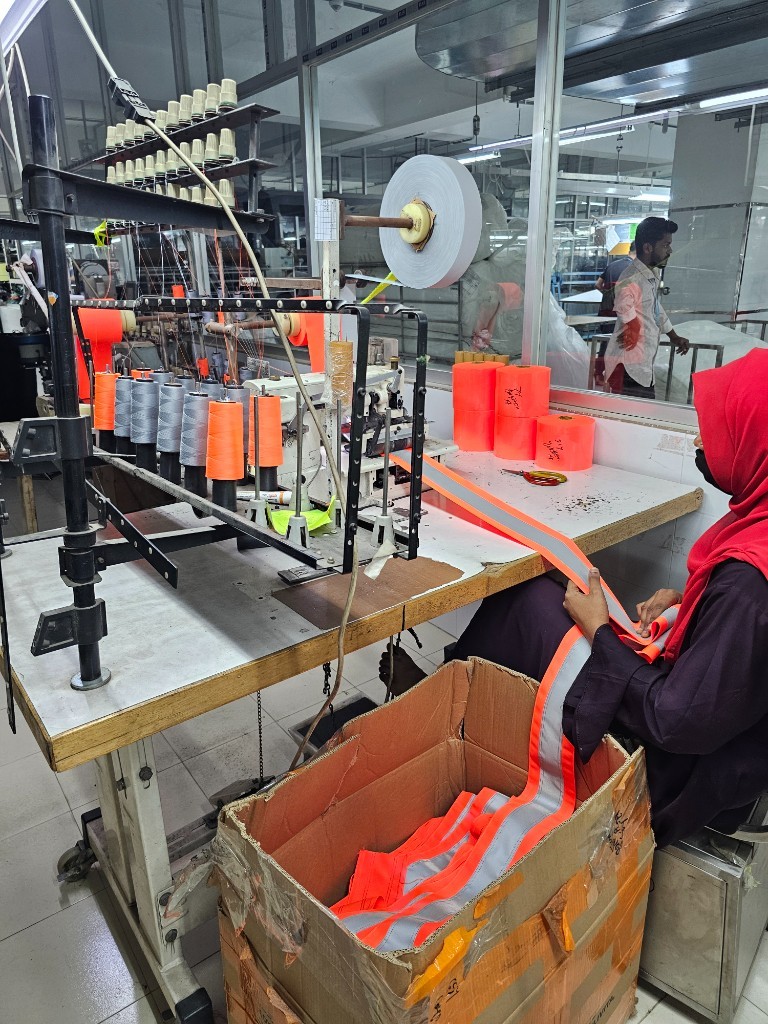
Heat-applied tape creates an additional variable because performance depends on the bond between tape and fabric.
Temperature, pressure and dwell time matter.
A tape that has good standalone data still needs to be applied correctly in production.
How to prevent it
Nominate the exact tape article and document the application conditions.
Where the garment will be repeatedly laundered, qualify the tape and garment substrate as a system rather than assuming that good tape plus good fabric automatically produces a durable combination.
5. The finished garment has insufficient fluorescent area
What goes wrong
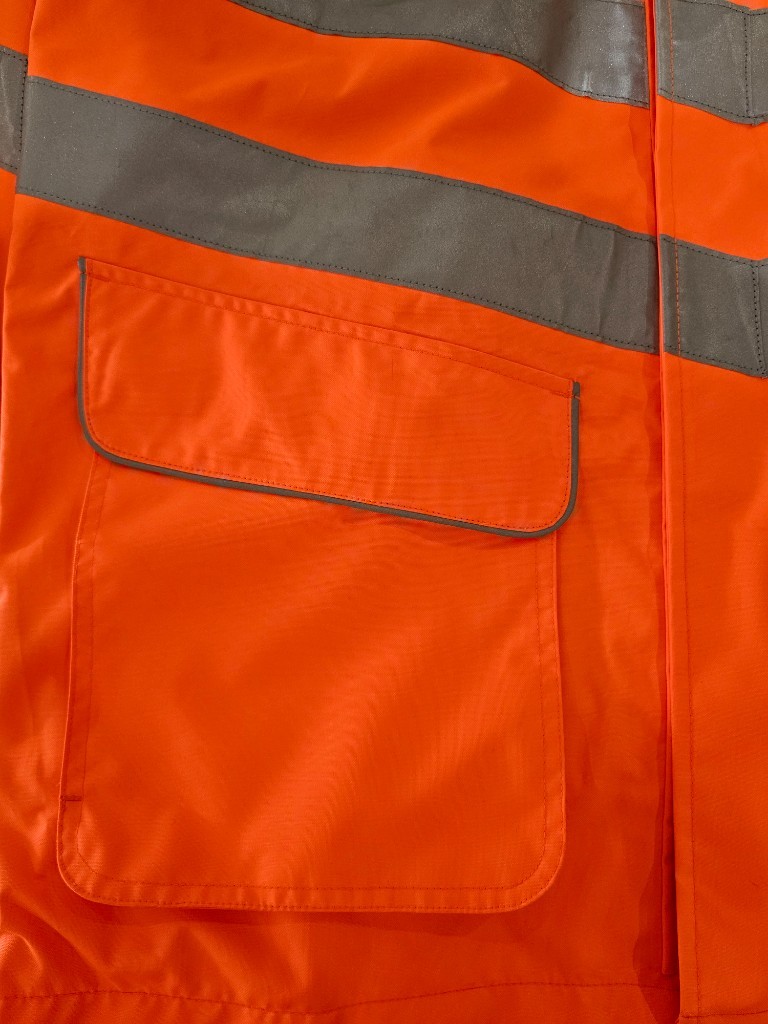
The individual material passes, but the finished garment does not contain enough qualifying fluorescent background material for its intended class.
BSIF confirms that EN ISO 20471 sets minimum visible areas for both fluorescent background material and reflective material.
Why it happens
The design gradually consumes the available area.
Common culprits include:
- dark shoulder panels
- contrast lower bodies
- knee reinforcement
- large pockets
- stretch inserts
- zip panels
- ID holders
- labels
- large branding areas
No single element necessarily causes the problem. It is often the cumulative effect.
How to prevent it
Calculate qualifying area before finalising the CAD and retain sensible margin above the minimum.
Do not wait until the certification sample has been completed.
For Class 1, 2 and 3 area requirements, refer to our EN ISO 20471 buyer's guide linked in the introduction above.
6. The smallest size falls short
What goes wrong
The development sample has adequate fluorescent and reflective area, but the smallest size in the commercial range does not.
BSIF states that the smallest garment is tested under the certificate to confirm that the minimum areas are maintained.
Why it happens
Developments are often conducted in a medium or large sample size.
By the time the garment is graded down, panels are smaller and the total qualifying area has reduced.
The risk is higher when the original design already sits close to the minimum.
How to prevent it
Check the smallest intended size while the pattern and design are still being developed.
For wide size ranges, do not assume that a successful base-size calculation automatically covers every size.
7. Branding changes the compliant area
What goes wrong
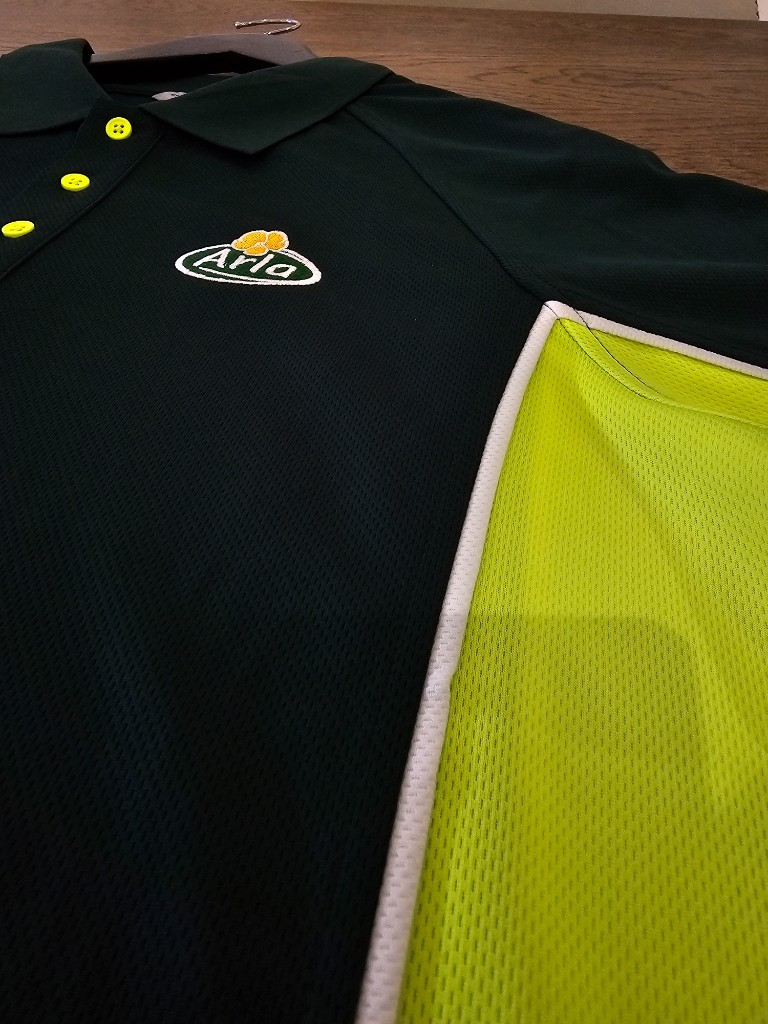
The garment initially has enough fluorescent material, but subsequent decoration reduces the visible area.
BSIF specifically highlights logo size as a compliance consideration because branding covers fluorescent material and may affect garment classification.
Why it happens
Branding is frequently managed separately from garment certification.
The product team approves the garment, and corporate logos, wearer identification or customer decoration are added afterwards.
On a garment with large excess area, that may not cause an issue. On a design already close to the minimum, it can.
How to prevent it
Define maximum branding zones as part of the approved specification.
If products will be sold blank and decorated later, make sure whoever applies the branding understands the restrictions.
8. Reflective tape is positioned incorrectly
What goes wrong
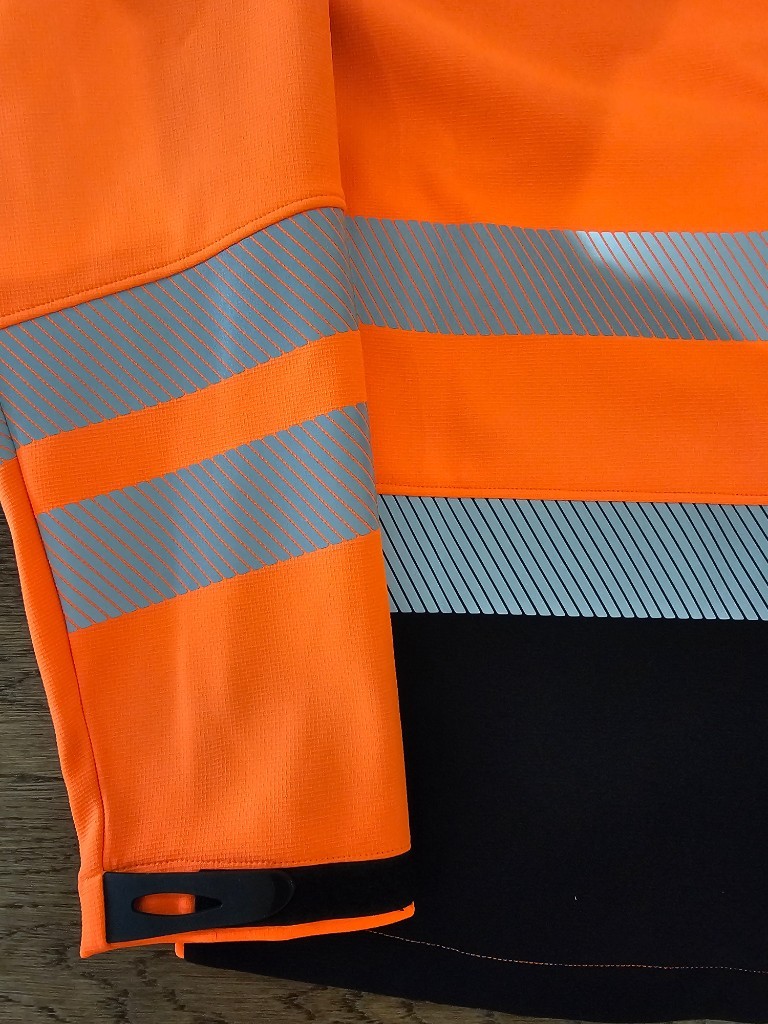
There may be enough reflective material in total, but its configuration on the garment is unsuitable.
ISO describes EN ISO 20471 as covering not only minimum areas but also the placement of high-visibility materials.
Why it happens
The garment is designed visually first, and the reflective route is then adjusted around:
- pockets
- zips
- seam lines
- branding
- reinforcement panels
- styling features
A band gets moved or interrupted because the alternative looks cleaner on the CAD.
For ordinary trim this might be harmless. For visibility material it can change the technical design.
How to prevent it
Review tape positioning before the pattern is finalised.
The reflective layout should be part of the garment architecture from the first development sample, not fitted around everything else at the end.
9. The fabric changes excessively after care
What goes wrong
Shrinkage or other dimensional change affects the material after laundering.
SATRA identifies dimensional stability following relevant after-care treatment as part of the performance considerations for protective clothing materials.
Why it happens
Possible causes include:
- insufficient fabric relaxation
- unstable knitted construction
- poor finishing control
- inappropriate care claim
- fabric substitution
- production material behaving differently from the development lot
Excessive dimensional change can create both a conventional quality problem and a technical performance problem.
How to prevent it
Approve the material against the intended care route and monitor bulk performance.
For garments expected to undergo demanding or repeated laundering, the care claim should influence material selection from the beginning.
10. A supplier substitutes "equivalent" material
What goes wrong
The garment that goes into production is not technically the same product that was originally reviewed.
This is one of the most important production risks in PPE.
SATRA describes type-examination as involving both testing and review of technical documentation identifying materials and manufacturing information, with quality procedures intended to support ongoing conformity.
Why it happens
The reasons are often ordinary commercial problems:
- the nominated tape is out of stock
- the mill misses the production deadline
- a cheaper fabric becomes available
- a coating changes
- a trim supplier is replaced
- the factory moves production
- a component MOQ becomes impractical
The replacement may even be a good product.
That does not make it automatically interchangeable.
How to prevent it
Identify the critical components in the approved BOM and control changes.
At minimum this should include the fluorescent background material and reflective system, together with any other component or construction detail that can affect the assessed performance.
Substitution should trigger review, not silent approval on the production floor.
11. Application settings change between development and bulk
This deserves separate attention because the material itself may not be the problem.
With heat-applied reflective tape, logos and other bonded components, the final performance depends partly on how they are applied.
A development room may use one heat press, while the production line uses another.
Temperature can differ.
Pressure can differ.
Dwell time can differ.
Operators may increase line speed.
The result is that the same tape and the same fabric do not necessarily create the same bond.
How to prevent it
Record application parameters during successful development and make them part of the bulk production specification.
Bulk quality control should check the process as well as the visual result.
12. The production team is working from the wrong approval
Another surprisingly basic failure mode is document control.
The development team makes several rounds of samples.
Fabric changes in round two.
Tape changes in round three.
The logo becomes larger after a customer meeting.
A final report exists, but the factory's production file contains an earlier BOM or CAD.
The issue is not knowledge of EN ISO 20471. It is ordinary product-management control.
For PPE, that ordinary mistake can become a compliance problem.
How to prevent it
Maintain one clearly identified final specification containing:
- approved fabric article
- approved fluorescent colour
- approved reflective tape
- tape application parameters
- approved panel construction
- branding limits
- intended size range
- care instructions
- relevant test and certification references
The factory, buyer, quality team and testing route should all be working against the same version.
Why an experienced hi-vis factory can still have failures
Factory experience is valuable, but "we make lots of hi-vis" is not a technical control.
A basic vest may contain relatively few components.
A modern technical jacket might include fluorescent shell fabric, waterproof membrane, seam tape, several contrast fabrics, stretch sections, segmented reflective tape, waterproof zips, printed branding and a lining.
A stretch trouser can introduce multiple reinforcement and mobility panels while still needing to maintain the qualifying fluorescent area.
As product complexity increases, the number of ways to create a problem increases with it.
The relevant question is therefore how this particular product is being engineered and controlled. For hi-vis clothing manufacturing programmes, that engineering discipline matters as much as factory scale.
A better pre-testing checklist
Before submitting a final development for testing or certification, it is worth checking:
Developing a hi-vis range? Share your product brief and we will help you compare fabric specifications, tape systems and garment constructions against the intended EN ISO 20471 claim — before the laboratory becomes the first place anyone checks qualifying area or wash durability.
Material
- Is the exact fluorescent fabric article confirmed?
- Does the test evidence relate to the correct colour and construction?
- Is the intended care route covered?
- Have dimensional stability and relevant physical properties been reviewed?
Reflective system
- Is the exact tape article nominated?
- Is the application method documented?
- Has durability been considered against the required care claim?
- Is any substitute prohibited without technical approval?
Garment design
- Has fluorescent area been calculated?
- Has reflective area and positioning been reviewed?
- Has the smallest size been checked?
- Have logos, ID windows and permanent decorations been accounted for?
Production
- Does the bulk BOM match the approved product?
- Are critical materials locked?
- Are application parameters controlled?
- Is the correct technical file being used?
- Are bulk dye lots and key components being checked?
This is where most preventable problems should be found.
Testing should confirm the development, not finish it
The laboratory should not be the first place where anyone checks whether the garment has enough fluorescent area or whether the nominated tape survives the intended wash process.
Those questions belong much earlier.
A useful EN ISO 20471 development process works backwards from the required finished product:
intended use → classification → garment design → material selection → component testing → sample validation → certification → controlled bulk production
When that sequence is followed, testing becomes confirmation that the engineering is correct rather than an expensive troubleshooting exercise.
That is particularly important as hi-vis workwear becomes more technical. Stretch fabrics, waterproof constructions, segmented tapes, complex colour blocking and increased branding create better products, but they also leave less room for casual material substitution or late design changes.
The strongest hi-vis programmes control the product from fabric selection all the way through to the bulk garment.
Need help engineering an EN ISO 20471 programme?
Source Workwear supports buyers from fabric and tape selection through garment design, sample validation and controlled bulk production — so testing confirms the engineering rather than exposing gaps late.
Frequently asked questions
Why can a hi-vis garment fail EN ISO 20471 when it looks correct?
EN ISO 20471 measures performance, not appearance alone. Fluorescent colour is assessed instrumentally against chromaticity and luminance limits. Retroreflective tape must maintain defined performance after pre-treatment. The finished garment must contain sufficient qualifying material, arranged correctly — and those properties must survive specified care or exposure. A garment that looks right under office lighting can still produce an unacceptable lab result.
Is the sewing factory always responsible for a test failure?
No. The root cause may sit with the dye house, fabric mill, reflective-tape supplier, product designer, application process or an uncontrolled change made after the original garment was approved. The laboratory result exposes the problem, but the cause usually happened much earlier in the supply chain.
Does passing fabric testing mean the garment will pass?
No. Individual materials can pass while the finished garment fails — for example when contrast panels, pockets, branding or tape placement reduce qualifying fluorescent or reflective area, or when the smallest size in the range falls below minimum areas. EN ISO 20471 applies to the complete garment design as well as the materials.
Why is the smallest size tested under EN ISO 20471?
BSIF confirms that the smallest garment in the commercial range is tested under the certificate to verify minimum fluorescent and reflective areas are maintained. Developments are often conducted in a medium or large sample size; grading down reduces panel sizes and total qualifying area — a risk when the original design already sits close to the minimum.
Can logos and branding affect hi-vis compliance?
Yes. BSIF specifically highlights logo size as a compliance consideration because branding covers fluorescent material and may affect garment classification. On a design already close to the minimum qualifying area, corporate logos, wearer identification or customer decoration added after certification can push the garment out of compliance.