EN ISO 20471 Explained: The Complete Buyer's Guide to Hi-Vis Clothing Standards
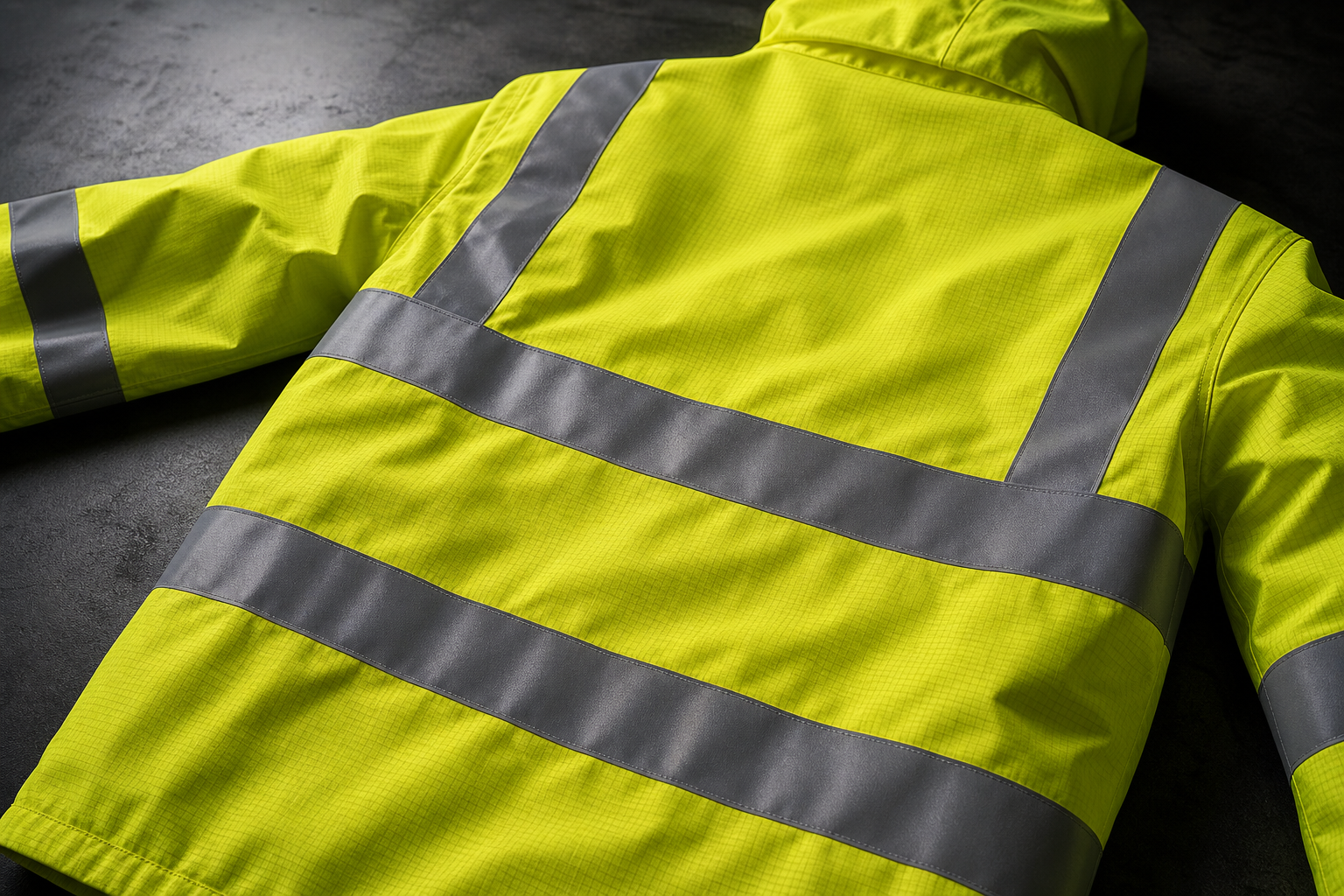
EN ISO 20471 is the main European standard for high-visibility clothing — the benchmark for hi-vis workwear sold into the European Union, EEA and United Kingdom. It defines minimum fluorescent and retroreflective areas, where tape must sit, how bright background colours must be, how tape must perform after washing, and what the label must show.
This guide covers the standard in full — written for buyers, brands and product teams sourcing or developing compliant hi-vis workwear for European markets, not for test laboratories.
In this article
- Which markets use EN ISO 20471 (and which use other standards)
- What the standard covers and how the three classes work
- Background colours, tape performance and placement rules
- Wash testing, labelling and documentation buyers should expect
- Hi-vis fabrics and tape systems
- Sourcing hi-vis in Bangladesh
- Our hi-vis manufacturing capability
EN ISO 20471 at a glance
| Topic | What to know |
|---|---|
| Markets | EU, EEA and UK (BS EN ISO 20471). US, Canada and AU/NZ use separate standards. |
| Legal basis (EU/UK) | Harmonised under PPE Regulation (EU) 2016/425 — Category II PPE with CE or UKCA marking. |
| Performance classes | Class 1, 2 and 3 — set by minimum fluorescent background area plus retroreflective tape area (both must pass). |
| Typical use (Annex A guide) | Class 3: roads above 60 km/h. Class 2: up to 60 km/h. Class 1: up to 30 km/h. |
| Colours | Fluorescent yellow, orange-red or red — each with defined colour and brightness tests. |
| Tape | Minimum 50 mm bands; separate-performance or combined (segmented) tape with different R′ targets. |
| Durability | Background and tape retested after washing — cycle count on label if stated, otherwise five cycles. |
| Label | ISO 7000-2419 symbol with class number, plus ISO 13688 marking and care information. |
Which markets use EN ISO 20471?
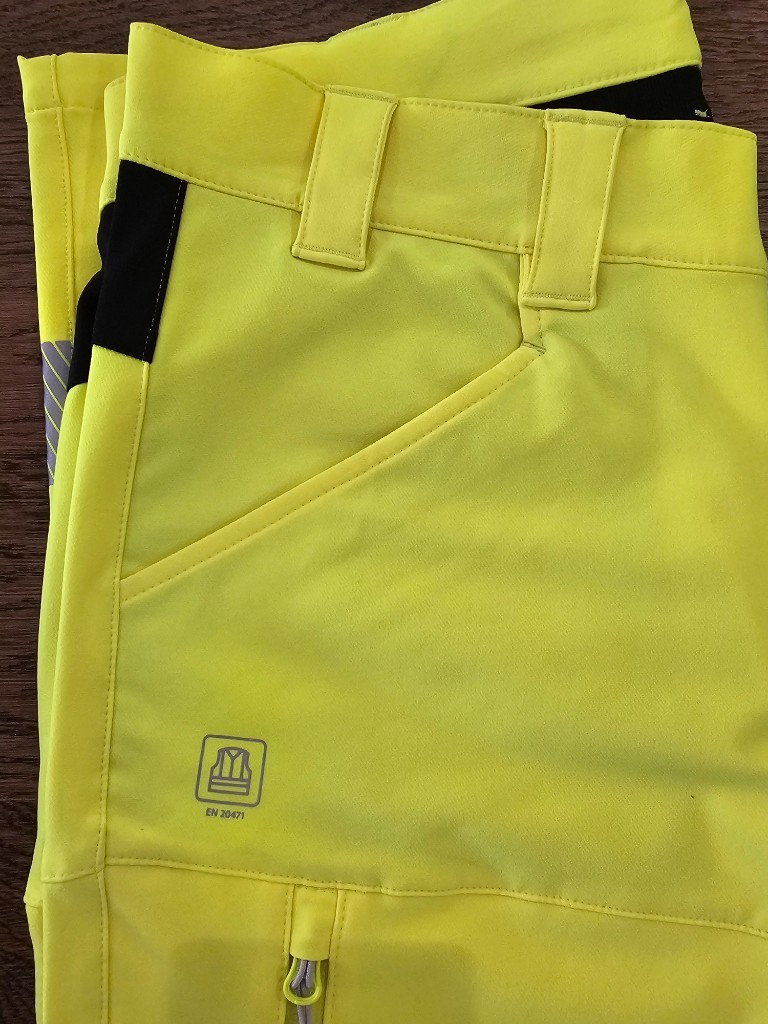
EN ISO 20471 is not a global hi-vis standard. Different export markets use different standards, with separate class systems, test methods and certification requirements. A garment certified to EN ISO 20471 does not automatically comply elsewhere.
| Market / region | Standard | What applies |
|---|---|---|
| European Union + EEA | EN ISO 20471 | Harmonised under EU PPE Regulation (EU) 2016/425. CE marking required for hi-vis sold as PPE. Replaced the earlier EN 471 standard. |
| United Kingdom | BS EN ISO 20471 | Identical technical requirements to EN ISO 20471. UKCA or CE marking under UK PPE Regulations. |
| United States | ANSI/ISEA 107 | Separate US standard with its own Type and Performance Class system. EN ISO 20471 certification does not satisfy US market requirements. |
| Canada | CSA Z96 | Canadian high-visibility safety apparel standard — separate classification and test requirements from EN ISO 20471. |
| Australia + New Zealand | AS/NZS 4602.1 | Separate day/night garment classification (Class D, D/N, N). Retroreflective materials tested to AS/NZS 1906.4. EN ISO 20471 certification does not satisfy AU/NZ requirements. |
For buyers running multi-market programmes, the specification must be split by destination. EN ISO 20471 governs EU and UK programmes. ANSI/ISEA 107 governs the US. AS/NZS 4602 governs Australia and New Zealand. Some material suppliers offer retroreflective tapes certified to multiple standards, but garment design, minimum area calculations and test documentation are standard-specific — they cannot be swapped between markets.
Source Workwear supports programmes selling into the UK, EU, United States and Australia, and factors the correct standard into fabric, tape and documentation planning from the development stage. For European hi-vis programmes specifically, a hi-vis clothing manufacturer needs to build the specification around EN ISO 20471 from the first tech pack — not retrofit compliance after sampling.
What EN ISO 20471 covers
The standard specifies requirements for high-visibility clothing intended to visually signal the wearer's presence to vehicle operators in daylight and under headlights in darkness. It applies to high-risk situations — where the risk of not being seen is significant enough that it requires structured protection.
It does not apply to medium-risk or low-risk situations. For context, Annex A of the standard sets out the risk framework: Class 3 applies where vehicle speeds exceed 60 km/h and the wearer is a passive road user (a worker, not a cyclist). Class 2 applies at speeds up to 60 km/h. Class 1 is for speeds up to 30 km/h with passive users.
The standard was prepared under ISO/TC 94, Subcommittee SC 13 (Protective clothing), and is harmonised with the EU under the PPE Regulation (EU) 2016/425. In Europe, compliance with EN ISO 20471 gives a presumption of conformity for visual signalling of the wearer's presence under Category II PPE. When published as EN ISO 20471, it carries both the ISO and CEN designations through the Vienna Agreement parallel processing route — the same technical document applies whether cited as ISO 20471 or EN ISO 20471.
The three performance classes
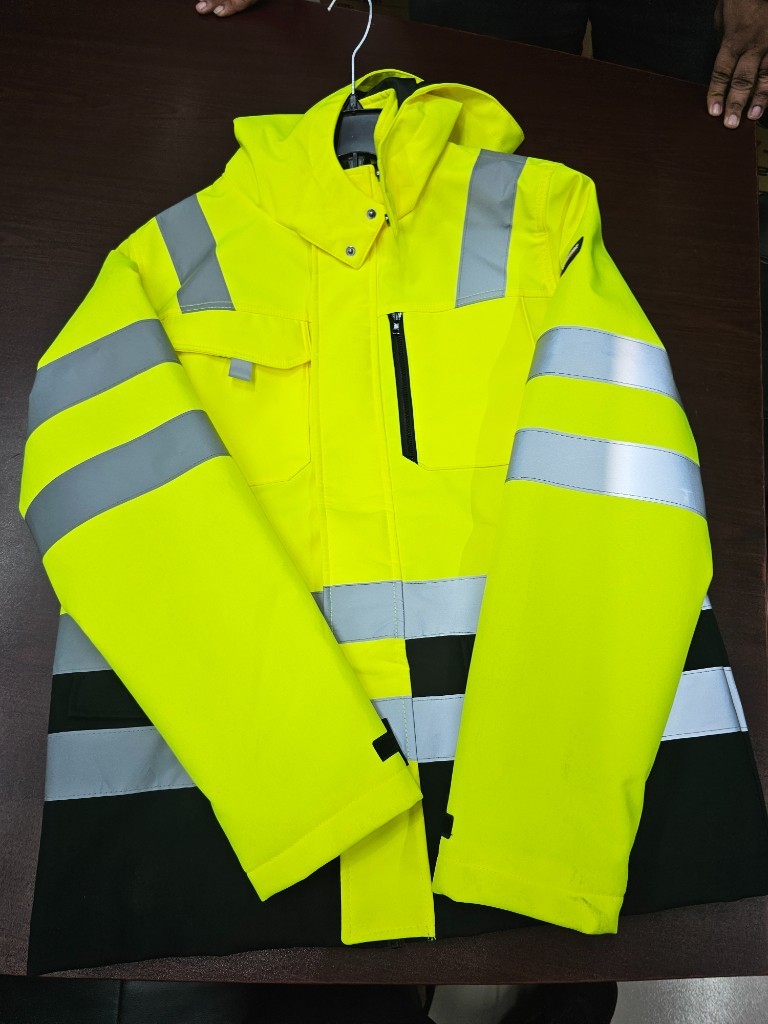
EN ISO 20471 defines three performance classes, each requiring minimum areas of fluorescent background material and retroreflective tape. The class is determined by whichever material area is smallest — both requirements must be met independently.
| Material | Class 3 | Class 2 | Class 1 |
|---|---|---|---|
| Background material | 0.80 | 0.50 | 0.14 |
| Retroreflective material | 0.20 | 0.13 | 0.10 |
| Combined performance material | n/a | n/a | 0.20 |
Areas are measured on the smallest garment size with all fasteners at their smallest configuration. The garment is measured flat, including torso, arms and legs as applicable.
The class can be achieved by a single garment or a clothing ensemble. A Class 2 jacket worn with Class 1 trousers can combine to Class 3 — but the higher class must be stated in the information for use and on the labels of both garments. Logos, lettering and labels must not reduce the minimum visible area of background material.
At least 50% (±10%) of the minimum background material area must be on the front of the garment.
Class 3 has an additional structural requirement: regardless of material areas, a Class 3 garment must cover the torso and must have either sleeves with retroreflective bands or full-length trouser legs with retroreflective bands — or both. A vest alone cannot be Class 3 no matter how large it is.
Background material: colour requirements
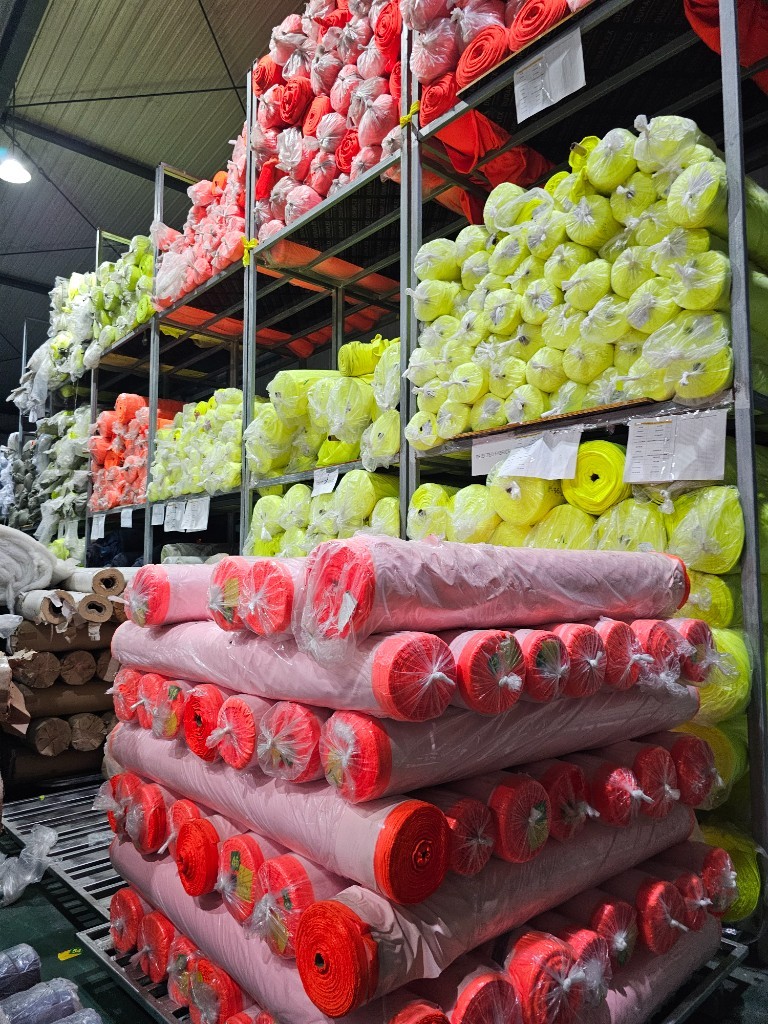
Three fluorescent colours are permitted under the standard. Each has defined CIE chromaticity coordinates forming a colour polygon, and a minimum luminance factor (β) that the material must achieve.
| Colour | Minimum luminance factor (β) |
|---|---|
| Fluorescent yellow | 0.70 |
| Fluorescent orange-red | 0.40 |
| Fluorescent red | 0.25 |
Fluorescent yellow is the highest performing in daytime conditions — its luminance factor requirement is almost three times that of fluorescent red. This is why it dominates road and construction workwear, where contrast against most backgrounds and signage is most critical.
The chromaticity requirement applies to new material and must be met after Xenon light exposure testing (accelerated weathering). After Xenon testing, the colour must remain within the permitted polygon — if it shifts from one colour box to another (e.g. from orange-red towards red), this must be stated in the manufacturer's instructions for use.
Additional colour fastness requirements apply to background material after standard test exposures. Colour fastness to rubbing must be at least grade 4 of the grey scale (dry rubbing per ISO 105 X12). Colour fastness to perspiration must achieve at least grade 4 for colour change and staining. Laundry colour fastness must meet grade 4-5 for colour change and grade 4 for staining.
For knitted background materials, dimensional change must not exceed ±5% in both length and width. For woven materials, tensile strength in weft and warp must be at least 100 N.
Retroreflective and combined-performance material
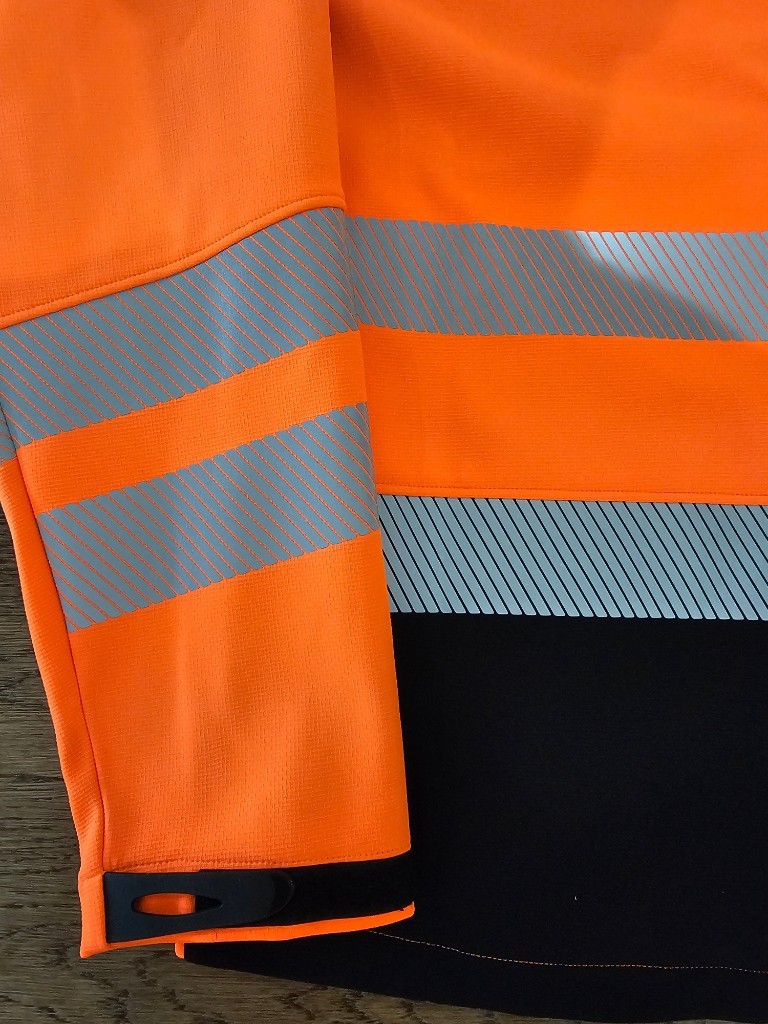
Separate-performance retroreflective material
Standard retroreflective sewn tape is the most widely used retroreflective material in hi-vis workwear. It performs as a retroreflector only — it does not contribute to the fluorescent background material area.
The coefficient of retroreflection R' is the performance measure. It is expressed in cd/(lx·m²). Higher values mean the material returns more light to the source — important for driver detection at distance in headlight conditions.
| Observation angle | Entrance angle 5° | Entrance angle 20° | Entrance angle 30° | Entrance angle 40° |
|---|---|---|---|---|
| 12 arc minutes | 330 | 290 | 180 | 65 |
| 20 arc minutes | 250 | 200 | 170 | 60 |
| 1° | 25 | 15 | 12 | 10 |
| 1°30' | 10 | 7 | 5 | 4 |
The key test geometry for compliance is 12 arc minutes observation angle and 5° entrance angle — this simulates a driver viewing a retroreflector at close range with headlights. The minimum R' of 330 cd/(lx·m²) is the benchmark most test reports lead with.
After physical exposure (abrasion, flexing, cold folding, temperature cycling, rainfall) and washing, the threshold drops to 100 cd/(lx·m²) at the same geometry.
Combined-performance material (segmented tape)
Combined-performance material functions as both fluorescent background and retroreflective material simultaneously. Its performance requirements are lower than separate-performance tape — but because it contributes to both area requirements, it can be more material-efficient in certain garment constructions.
| Observation angle | Entrance angle 5° | Entrance angle 20° | Entrance angle 30° | Entrance angle 40° |
|---|---|---|---|---|
| 12 arc minutes | 65 | 50 | 20 | 5 |
| 20 arc minutes | 25 | 20 | 5 | 1.75 |
| 1° | 5 | 4 | 3 | 1 |
| 1°30' | 1.5 | 1 | 1 | 0.5 |
After exposure, the R' minimum is 30 cd/(lx·m²) at 12'/5° — and when wet (during rainfall testing), it must exceed 15 cd/(lx·m²).
Combined-performance material can only be used for the Class 1 minimum area requirements in Table 1. It does not appear in Class 2 or Class 3 area calculations.
Orientation-sensitive materials
Some retroreflective materials perform differently depending on which direction they are positioned on the garment. If a material's retroreflection differs by more than 15% between rotation angles of 0° and 90°, it is classified as orientation-sensitive. Orientation-sensitive material must meet the full R' requirement at its better orientation, and at least 75% of that value at the other orientation — both on new material and after exposure.
Design requirements: how tape must be positioned
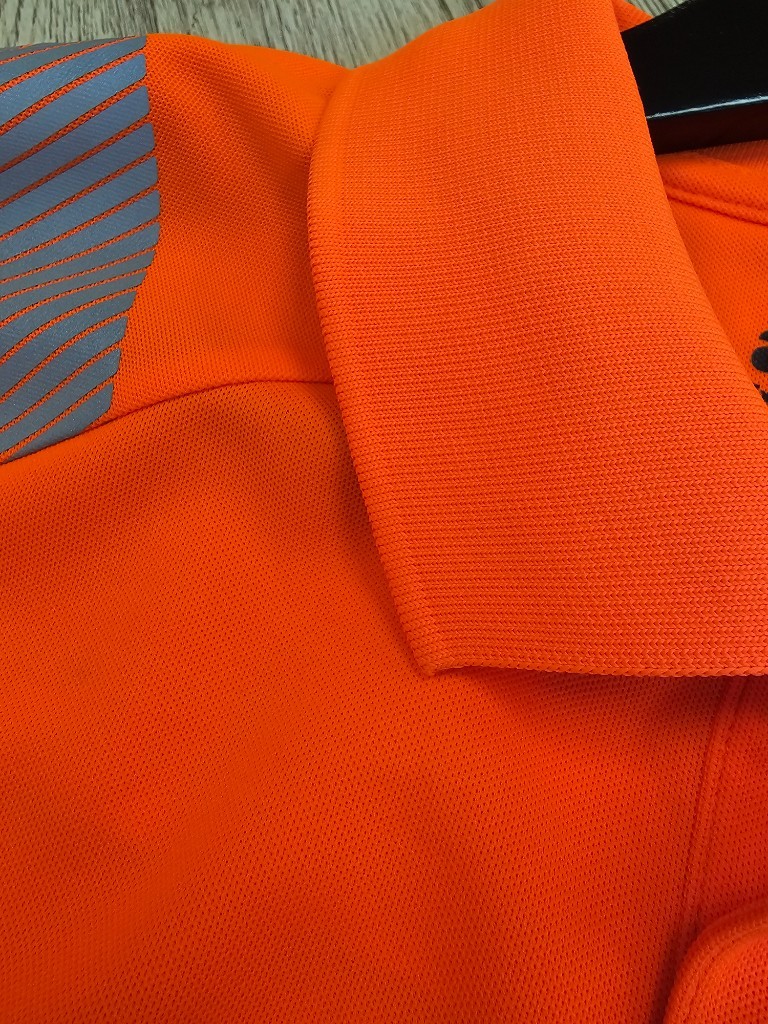
The design requirements in the standard are more specific than most buyers expect. They don't just require that tape is present — they define how it must encircle the body, how wide it must be, how it must transition between body and sleeves, and how much interruption is permitted.
All retroreflective bands: minimum width and continuity
Every band of retroreflective material must be at least 50 mm wide. Background material must maintain a minimum width of at least 50 mm wherever it appears. This applies around the torso, sleeves and legs.
Gaps in retroreflective bands — for seams, fastening systems and structural details — must not exceed 50 mm per gap. The total gaps in any one band around the torso must not exceed 100 mm. The total gaps around sleeves must not exceed 50 mm.
Torso-only garments (vests and tabards)
Torso-only garments must have:
- At least one band of retroreflective material encircling the torso, with a maximum inclination of ±20° to horizontal, plus bands passing over each shoulder from front to back, OR
- Two bands of retroreflective material at least 50 mm apart, encircling the torso within ±20° of horizontal
In both configurations, the bottom of the lowest band must be at least 50 mm above the bottom edge of the garment.
For tabards, any side gap must be no greater than 50 mm horizontally for a person of the correct size.
Torso and arm garments (jackets, shirts, coats)
Jackets require torso bands meeting the same rules as vest garments. When a sleeve obscures the view of a horizontal torso band, the sleeve must be encircled with a retroreflective band. For long-sleeved garments where the sleeve covers the torso band from view, the sleeve must carry two retroreflective bands at least 50 mm apart, with the lower band at least 50 mm above the sleeve edge.
This is the rule that catches the most garments during audit. The test for whether a sleeve "blocks a clear view" is done by visual inspection while moving the arm through its full range. A jacket with bands only on the torso and no sleeve bands will fail this requirement if the sleeve covers the torso band in any arm position.
Leg garments (trousers and bib-and-brace)
Trouser legs must have at least two bands of retroreflective material, each encircling the leg within ±20° of horizontal and at least 50 mm apart. The lower band must be at least 50 mm above the trouser leg hem.
Background material must encircle the trouser legs at minimum 50 mm width. The gaps rule applies: no single gap over 50 mm, measured parallel to the direction of the band.
Full coverage garments (coveralls)
Coveralls without sleeves must combine the torso-only and leg requirements. Coveralls with sleeves must combine the torso-and-arm and leg requirements. The same minimum widths, encircling rules and gap limits apply across all seams.
Wash and ageing testing
The standard requires that retroreflective material and background material maintain their performance after cleaning. If a maximum cleaning cycle count is stated on the label, testing must be completed at that number. If no maximum is stated, testing is done after five cycles.
Washing is carried out per the manufacturer's care instructions on a completed garment (or on prepared specimens for domestic laundering). The wash cycle includes both washing and drying. Industrial laundering follows specific sample preparation procedures defined in Annex B — bands of retroreflective material 250 mm × 50 mm are applied to a jacket at defined positions and the coefficient of retroreflection is averaged across eight bands after the cycle count.
After washing, retroreflective material must still meet the 100 cd/(lx·m²) threshold (separate performance) or 30 cd/(lx·m²) (combined performance).
Physical exposure tests beyond washing include:
- Abrasion: 5,000 cycles using wool abradant at 9 kPa (ISO 12947-2)
- Flexing: 7,500 cycles (ISO 7854 method A)
- Cold temperature folding: at −20 ±2°C (ISO 4675)
- Temperature variation: 12 hours at 50°C then 20 hours at −30°C
- Rainfall: continuous spray simulating 284 mm/h rain rate (Annex C)
Each of these is applied separately. After exposure to each, the sample must still meet the relevant R' minimum.
Physiological performance: breathability
The standard includes a breathability requirement that applies to all garments except tabards and waistcoats.
For garments offering rain protection (coated, laminated and PU-coated fabrics), the garment must be tested and classified against EN 343 for water vapour resistance and rain penetration. The EN 343 classes achieved must be declared.
For other garments, the water vapour resistance must be lower than 5 m²Pa/W. If the water vapour resistance exceeds this, the thermal resistance (ISO 11092) must be measured and the water vapour permeability index must be ≥ 0.15.
This requirement exists because high-risk workwear is typically worn for extended periods during physical activity. A garment that traps heat and moisture creates a secondary safety risk. It is one reason why breathable coatings and laminates are preferred over fully coated non-breathable shells for hi-vis outerwear — a safety outerwear manufacturer sourcing this category needs to verify Ret values at fabric stage, not after sampling.
Marking: what must appear on the label
The graphical symbol ISO 7000-2419 (the high-visibility clothing symbol) must appear on the permanent garment label, with the class number shown adjacent to it. This is the visible declaration of the performance class.
If a maximum number of cleaning cycles is stated in the manufacturer's instructions, that number must appear on the permanent label near the graphical symbol. The standard requires that the information for use includes the statement: "The stated maximum number of cleaning cycles is not the only factor related to the lifetime of the garment. The lifetime will also depend on usage, care, storage, etc."
All other marking requirements of ISO 13688 apply — size designation, care labelling, manufacturer identification and country of origin as required by the destination market.
What the risk assessment framework means for buyers
Annex A of EN ISO 20471 sets out the relationship between risk level, vehicle speed, type of road user and the required performance class. It is informative rather than normative — it guides users selecting appropriate garments, rather than defining test requirements.
The framework distinguishes between passive road users (workers focused on tasks rather than watching traffic — the typical hi-vis buyer's customer) and active road users (cyclists, pedestrians using the road as part of normal movement). Passive road users at speeds above 60 km/h require Class 3. At speeds up to 60 km/h, Class 2 is required. At speeds up to 30 km/h, Class 1 applies.
The note to the table makes clear that local factors — weather, background contrast, traffic density — can move a situation into a higher risk class. A buyer developing a programme for construction workers operating near motorways should be specifying Class 3 regardless of whether their brief says "site workwear."
What this means when sourcing hi-vis workwear
Material specification has to come first
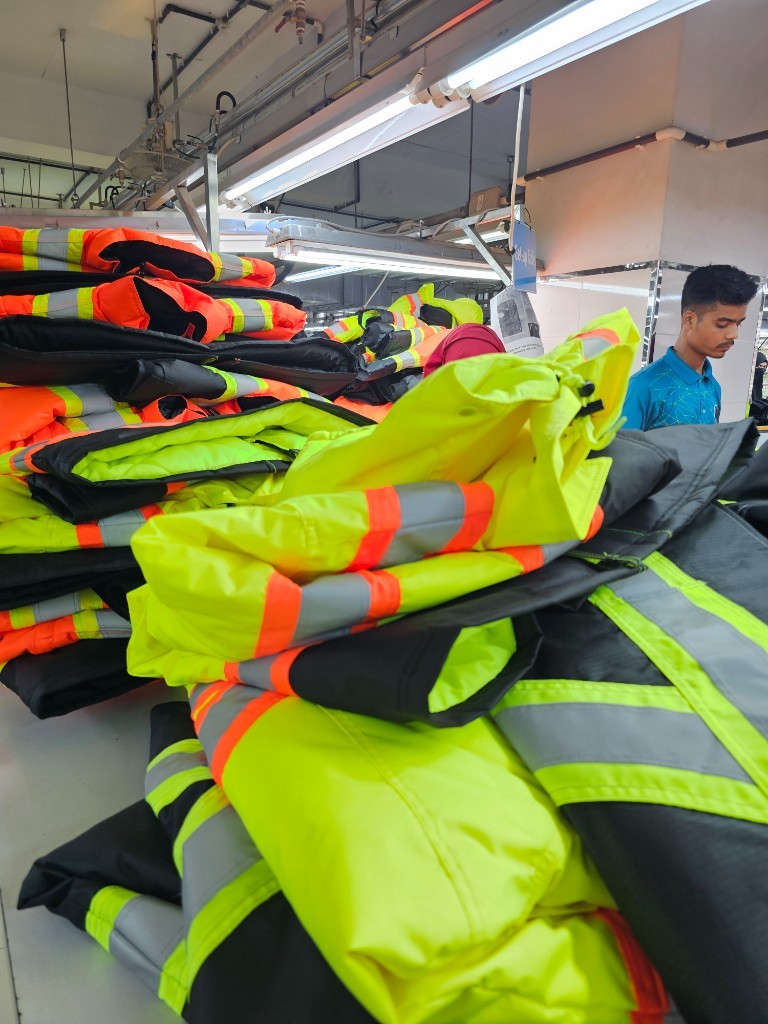
Retroreflective tape sourcing is the single biggest variable in whether a hi-vis garment can achieve EN ISO 20471 certification. Not all reflective tapes meet the R' minimums. Not all fluorescent background fabrics meet the chromaticity and luminance requirements of Table 2. In Bangladesh, many specialty fluorescent fabrics and certified tapes are imported — primarily from China. That import route needs to be managed as part of the programme specification, not resolved after sampling.
For programmes including segmented tape (combined-performance material), tape availability and wash durability are even more critical. Segmented tape requires compatible heat-transfer application and specific wash-testing before it can be declared compliant.
Test reports need to confirm the right geometry
A test report that shows retroreflection results at a single observation and entrance angle is not useful unless it explicitly references the geometry in Tables 4 or 5 of EN ISO 20471. The key measurement is at 12 arc minutes and 5° entrance angle. Reports from material suppliers that only show 0.2° observation angle are citing a different test geometry entirely. Make sure the test report specifies which table and which geometry applies to the certificate.
The wash count on the label is a contractual commitment
If a manufacturer marks "Maximum 50 washes" on a garment, the retroreflective tape and background material must have been tested to 50 wash cycles and passed. That number cannot be inflated to appear more durable than the tested material allows. Buyers specifying garments for tender procurement should confirm the wash count matches the programme's service life expectation — typically a minimum of 25 domestic cycles for commercial workwear.
Combining garments to achieve Class 3
Vest and trouser combinations are a practical way to achieve Class 3 for programmes where a full jacket is impractical in warm conditions. Both garments must be individually classified, and the combined class must be stated on both labels. The visible area calculation uses what is actually visible when both garments are worn together — panels hidden by overlap do not count. A hi-vis clothing manufacturer developing this kind of ensemble needs to confirm the area calculations hold on the smallest size across the range, not just on the sample size.
Bangladesh supply chain context
Bangladesh is building genuine capability for EN ISO 20471-compliant hi-vis workwear — from basic vests through segmented-tape polos to taped-seam outerwear. The factories able to produce this at export quality are a fraction of the broader garment industry, but they exist. The material supply chain for certified fabrics and tapes is largely imported from China, which adds lead time and import management to the programme. Understanding the hi-vis supplier landscape in Bangladesh helps buyers set realistic expectations about factory selection and minimum quantities — a hi-vis clothing manufacturer working through a managed sourcing partner will typically have access to capable factories at more realistic entry quantities than going direct.
For buyers developing or scaling a private-label hi-vis range, the starting point is always specification: class, colour, wash count commitment, and destination market. Those decisions determine factory capability requirements, material sourcing routes and the documentation structure needed to support a compliant product from production through to market.
Source EN ISO 20471-compliant hi-vis workwear
Source Workwear manages hi-vis garment development and production in Bangladesh — including material specification, retroreflective tape selection, compliance documentation and test report management. If you're building a private-label hi-vis range or resourcing an existing programme, we can help you get the specification right from the first sample.
Frequently asked questions
What is EN ISO 20471?
EN ISO 20471 is the international standard for high-visibility clothing — formally titled 'High visibility clothing: Test methods and requirements'. It defines three performance classes based on the minimum areas of fluorescent background material and retroreflective tape, sets the permitted colours for background material, specifies retroreflective performance values (the coefficient of retroreflection R'), sets minimum tape width and placement rules, requires wash durability testing, and defines what must appear on the garment label. It applies to garments worn in high-risk situations where the wearer needs to be visible to vehicle operators in both daylight and darkness.
What are the three classes of EN ISO 20471?
Class 3 requires 0.80 m² of fluorescent background material and 0.20 m² of retroreflective material — the highest level, covering torso plus sleeves or legs. Class 2 requires 0.50 m² background and 0.13 m² retroreflective — typically jackets and waistcoats. Class 1 requires 0.14 m² background and 0.10 m² retroreflective (or 0.20 m² combined-performance material) — vests and tabards at the lower end. Class 3 is required for speeds above 60 km/h. Classes can be achieved by combining two classified garments, e.g. a Class 2 jacket with Class 1 trousers can meet Class 3.
What colours are permitted for EN ISO 20471 background material?
Three fluorescent colours are permitted: fluorescent yellow, fluorescent orange-red, and fluorescent red. Each has defined CIE chromaticity coordinates and minimum luminance factors specified in Table 2 of the standard. Fluorescent yellow has the highest minimum luminance factor of 0.70; fluorescent orange-red is 0.40; fluorescent red is 0.25. The colour must remain within the permitted chromaticity box after Xenon light exposure testing.
What is the minimum width for retroreflective tape on EN ISO 20471 garments?
All bands of retroreflective material must be at least 50 mm wide. Background material must also maintain a minimum width (height) of 50 mm. Gaps in the continuity of retroreflective bands — for seams, fasteners and other construction features — must not exceed 50 mm per gap, with a total of no more than 100 mm of gaps in any one band around the torso. On sleeves, the maximum total gap is 50 mm.
What is the retroreflective performance requirement for EN ISO 20471?
For separate-performance retroreflective material (standard sewn tape), the coefficient of retroreflection R' must be at least 330 cd/(lx·m²) at 12 arc minutes observation angle and 5° entrance angle on new material. After washing and physical exposure tests, this falls to a minimum of 100 cd/(lx·m²) at the same geometry. For combined-performance material (segmented tape), the new material minimum is 65 cd/(lx·m²), falling to 30 cd/(lx·m²) after exposure (15 cd/(lx·m²) when wet).